

Before someone calls you, clicks your site, or walks through your door, they have already formed an opinion of you. They checked your website. They read your reviews. They compared you to the business down the street. They noticed whether your Instagram looks like your homepage, and whether your homepage sounds like the person who eventually picks up the phone.
That is not a marketing theory. It is a habit, and the numbers back it up. In BrightLocal's 2026 Local Consumer Review Survey, 97% of consumers said they read reviews for local businesses, and 41% said they always do it before making a decision. By the time a prospect reaches out to you, they have usually already made up their mind about who you are.
Getting attention has never been simpler. Earning belief is a different job entirely, and it is the job most businesses skip.
Reputation Is Not a Feeling. It Is a Pattern.
People do not trust businesses because of a single ad, a single five-star review, or a single well-designed page. They trust businesses because everything they encounter tells the same story. Edelman's 2026 Trust Barometer, a survey of nearly 17,700 people across 15 countries, found that 88% of consumers now rank trusting a brand as an important or critical purchase factor, right alongside quality and price. Trust is not a soft metric anymore. It is a buying criterion, measured the same way you measure whether something is worth the cost.
That pattern gets built or broken across three things: consistency, proof, and clarity.
Consistency
Consistency means your business looks, sounds, and behaves the same way everywhere a customer finds you. Your Instagram grid, your website, your invoices, your voicemail greeting. If any one of those feels like a different company, the whole reputation gets shaky.
This is not a design preference. It has a dollar figure attached to it. A widely cited study from brand platform Lucidpress found that consistent branding can lift revenue by as much as 33%, and that same research found 81% of companies openly admit they struggle to keep their own content on brand. Most businesses know this is a problem. Very few fix it.
Proof
Proof is the evidence that backs up what you claim. Reviews, testimonials, before and after work, client results. This is where the numbers get loud. BrightLocal found that 85% of consumers say positive reviews make them more likely to use a business, and 77% say negative reviews push them away just as fast. Nearly half of consumers, 47%, will not even consider a business with fewer than 20 reviews, no matter how good those reviews are.
Proof is not optional anymore. It is the first thing a stranger checks before they trust your word for anything.
Clarity
Clarity means a customer can understand what you do and what you stand for without having to work for it. If your reputation requires an explanation, it is not clear enough yet. The businesses that grow fastest are the ones a customer can describe to a friend in one sentence.
What This Looked Like for a Real Client
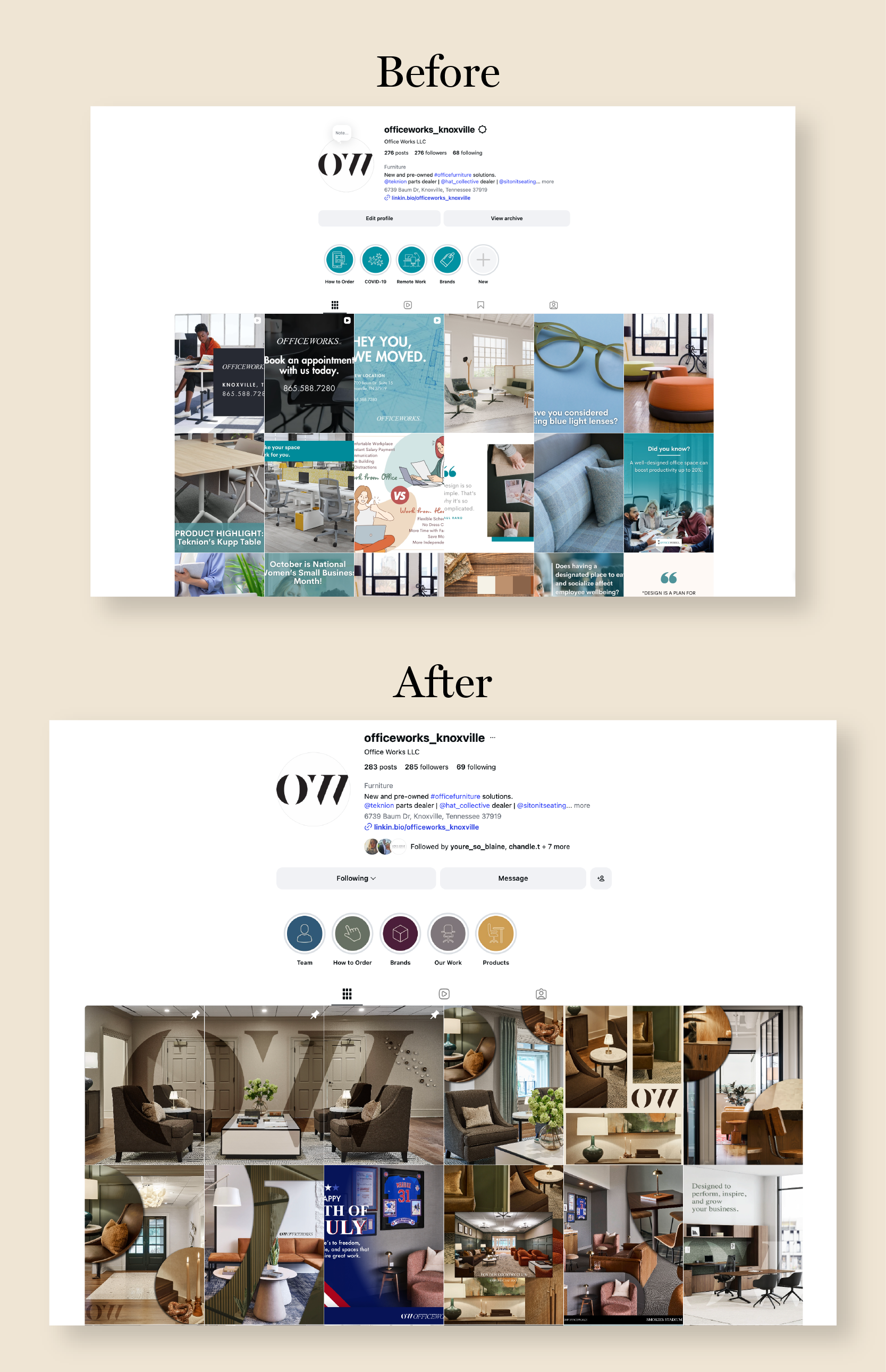
Office Works LLC, a Knoxville office furniture company, came to us with a social media presence that did not match the quality of the work they actually do. Beautifully-designed spaces and high-end furniture were getting buried under a cluttered, inconsistent feed.
We refreshed the visual palette, elevated the photography, and cleaned up the typography so every post looked like it belonged to the same company that builds those spaces. Nothing about the furniture changed. What changed was whether their online presence told the truth about the quality already sitting in their showroom. That is the entire job of reputation work. Make the outside match the inside.
Trust Is Earned Before the First Conversation
By the time someone reaches out to you, decides to visit, or picks up the phone, they have already read your reviews, scrolled your feed, and formed an opinion. The businesses that win are not the loudest ones. They are the ones whose story holds up no matter where a customer encounters it.
If your website says one thing, your ads say another, and your social feed has not been touched in months, that is not a channel problem. It is a clarity problem, and it is fixable.
Your reputation arrives before you do. Make sure it is telling the truth.